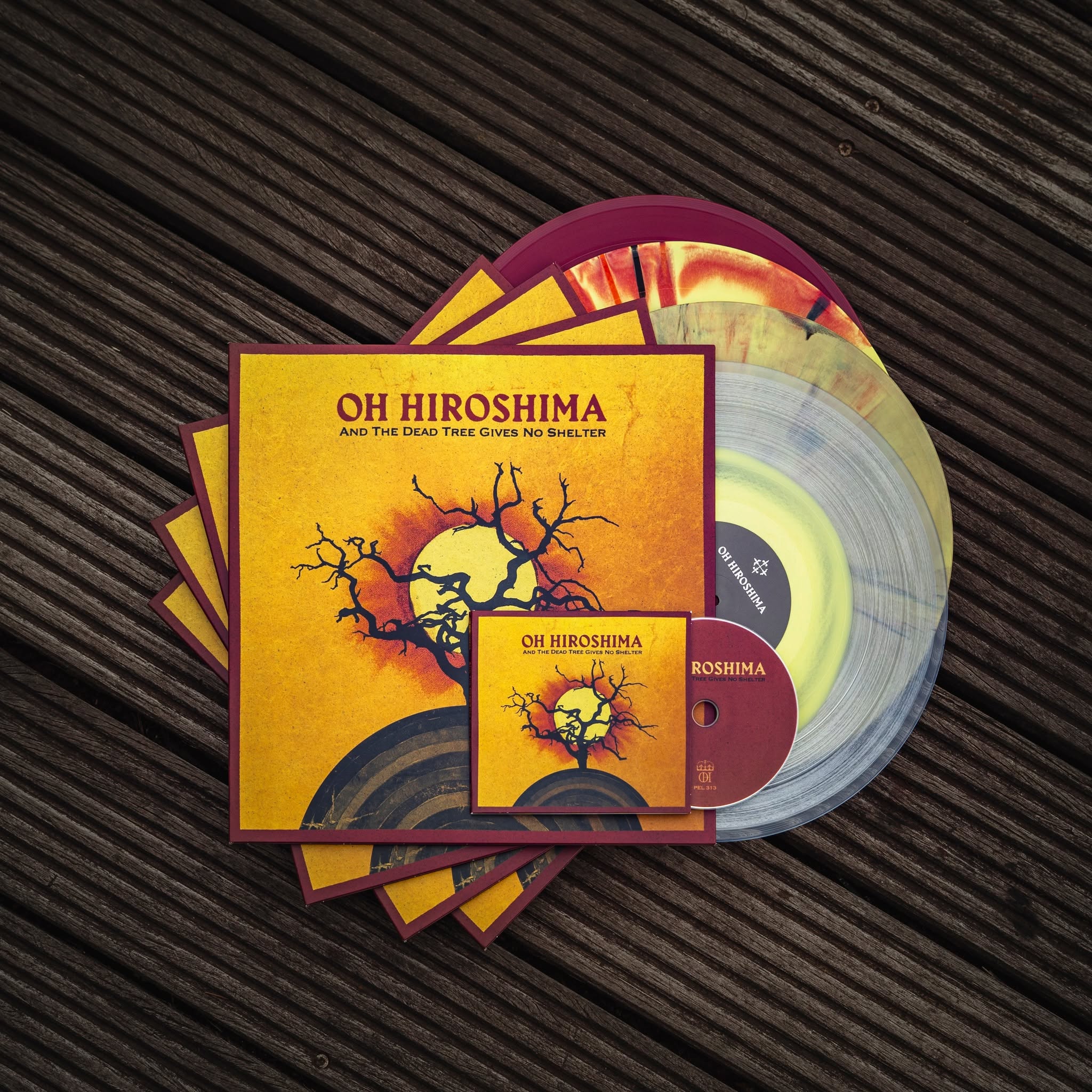
No Shelter. Still Hope, The Swedish Duo Have Stopped Pretending the Light Will Find You.
There was a time when post-rock seemed convinced that every storm had a purpose. Build slowly. Add guitars. Add more guitars. Hit the big chord. Stare meaningfully at the horizon. Congratulations: transcendence achieved.
Oh Hiroshima have apparently stopped trusting the weather :‘And The Dead Tree Gives No Shelter’, is not an album without hope. That would be easier. Pure despair has its own strange comfort: if everything is doomed, at least you can stop worrying about what to do next. This record asks something far less convenient.
What if the world is genuinely getting harder to believe in — and you still have to find a reason to care?
The album title ‘And the Dead Tree Gives No Shelter’ is taken from T. S. Eliot’s epic poem The Waste Land. For this album, the dead tree works as a metaphor for ways of living that drain the world of meaning and offer no real way of navigating the hardships of life.
We are living in a time when it has become harder and harder to imagine a bright future. This leaves many of us with a deep sense of hopelessness that easily breeds cynicism and apathy. In that state it becomes easy to shut the world out and give up any attempts at meaningful interaction with the world around us.
A destructive cycle follows, as this leaves us with no way of sheltering ourselves from our initial despair at the state of things. But these songs also aim to paint something meaningful and hopeful. A form of idealization not rooted in naivety but in realism, because we need ideals to gather enough strength to leave the shelterless dead trees of our lives behind.” (Jakob Hemström, Oh Hiroshima)
So no, this is not a hopeful record in the conventional sense. It is something more useful: a record about the necessity of hope when hope is no longer convincing.
The Crescendo Is Not Coming to Save You
Much of Oh Hiroshima’s established language remains intact. Panoramic guitars. Clean vocals suspended somewhere between intimacy and distance. Drums that know exactly when to make the ground move. But something has changed.
Previous Oh Hiroshima records often seemed to hide some form of light beyond the next crescendo. This time, the band are far less generous. “Skeleton Key” seems built for catharsis before a heavy, sombre groove pulls it deeper into itself. “Broken Sunlight” gets close enough to brightness that you can almost touch it — then answers with one of the album’s most oppressive eruptions.
The light was there. It just didn’t survive.
That is where And The Dead Tree Gives No Shelter becomes more than another beautifully sad post-rock record. Oh Hiroshima know exactly where you expect release. And exactly how much it hurts to take it away.
Post-Rock, But Not Quite Where You Left It
Calling Oh Hiroshima a post-rock band has never been wrong. It has just become increasingly incomplete.
The panoramic scale may still speak to listeners of MONO, Caspian, God Is An Astronaut or This Will Destroy You, but ‘And The Dead Tree Gives No Shelter’ is less interested in their familiar routes towards transcendence. “Meridian” moves with a nervous progressive pulse. “Angelos” lets strings, soft vocals and restrained heaviness coexist without using aggression as an easy shortcut. “Tree Of Life” offers the album’s clearest glimpse of something brighter — not sunlight after the storm, but the first light while you are still not entirely sure another storm is not coming.
Elsewhere, the album moves closer to the tragic grandeur of Crippled Black Phoenix and the psychological weight of Porcupine Tree’s ‘Signify’, ‘Stupid Dream’ and ‘In Absentia’ era. Not because Oh Hiroshima suddenly sound like either band, but because they share that same understanding of how melancholy can live inside a groove.
This sadness has a body. The bass moves. The drums hit. The music can be majestic without becoming triumphant, and heavy without reaching for familiar post-metal theatrics. By now, Oh Hiroshima mostly sound like themselves. After fifteen years, that is probably the point.
Sometimes the Tree Is Dead
By the time “Exit Cloud” arrives, the album has earned the right to offer some kind of release. Naturally, it does not make things that simple. The atmosphere feels lighter, but never completely safe. There is still thunder somewhere in the distance. And perhaps that is the closest ‘And The Dead Tree Gives No Shelter’ comes to an answer. Not sunlight. Rain. Not salvation. Nourishment.
Post-rock has spent decades promising that if you wait long enough, the crescendo will come and everything will make sense. ‘And The Dead Tree Gives No Shelter’ knows better. Sometimes the tree is dead. Sometimes there is no shelter. You still have to decide what to plant next.
“We tracked the foundation of the record (drums, bass and electric guitars) at Studio Gröndahl with Karl Daniel Lidén (Swarm of the Sun), who has worked with many really good bands before… he took great care in the drum setup and recording, and we’re especially happy with how that turned out.
The rest of the album was recorded in Örebro by me and my brother, with a little help from some friends of the band. Production-wise this is our most ambitious record by far because of the number of instruments and musicians that contributed.
Ten additional musicians were involved this time around. Magnus Lindberg mixed and mastered the album. It’s the third time in a row. He’s great to work with, has a great résumé, and always delivers quality work.” (Jakob Hemström)