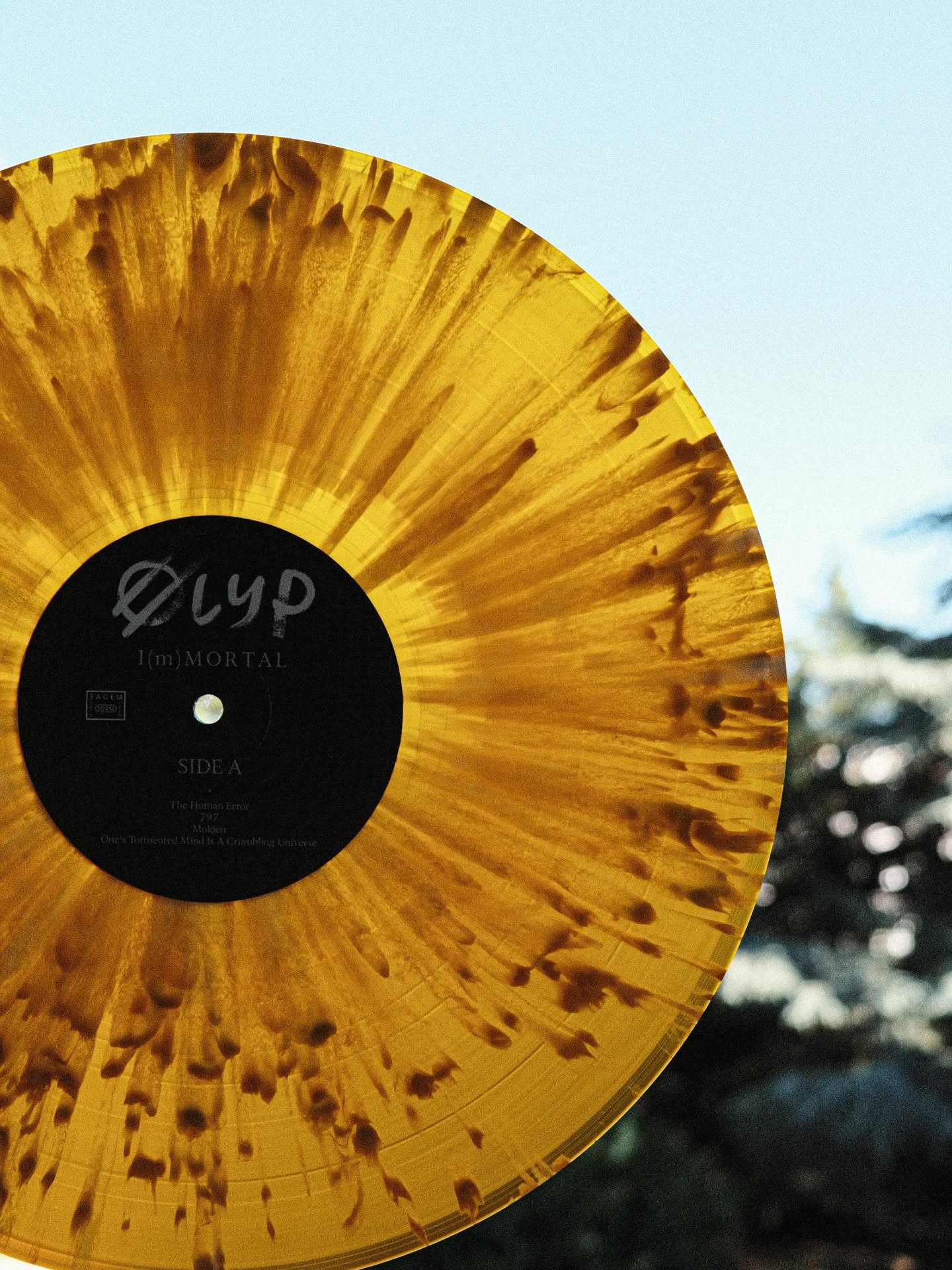
Born in the Norwegian fjords and now operating between southern France and Belgium, ØLYP turn environmental concern, human contradiction and the search for balance into the cinematic instrumental progressive metal of their debut album, I(m)MORTAL.
Some bands begin in rehearsal rooms. ØLYP began with a landscape — and a fairly uncomfortable question.
Surrounded by the Norwegian fjords, guitarist and bassist Thibaud Lépicier and drummer David Annenkoff found themselves confronting the growing distance between humanity and the natural world. Many of us admire nature, photograph it and cross borders to experience it, while living within systems that make our connection to what happens next increasingly easy to ignore.
That contradiction became the starting point for ØLYP.
The project has since acquired a rather more complicated geography. With its members now based between southern France and Belgium, the duo no longer belongs to one fixed location. That might have been a serious obstacle at another time. Today, creating a record together no longer necessarily requires sharing a postcode, a rehearsal room or even the same national weather forecast.
Norway provided the original setting and the questions that followed. France and Belgium provided the space in which those questions became ‘I(m)MORTAL’, ØLYP’s debut album, released through Klonosphere — home to Hell Is Nothing, Inner Landscape and Nihil, among others — with distribution handled by Season of Mist.
“When we began writing ‘I(m)MORTAL‘, we wanted to explore our relationship with nature without relying on lyrics. The album is about the rupture within that relationship, but also about its beauty and everything nature gives us emotionally, far beyond material resources. It follows that connection as it deteriorates, to the point where destroying the natural world also means destroying ourselves.
— ØLYP »
Between progressive and post-metal vibes, the record reflects on environmental collapse, collective inaction and the individualism increasingly shaping modern society. There is no singer, manifesto or convenient narrator to settle the argument. The music has to carry it.
ØLYP use riffs, rhythmic movement, repetition and silence to create a conversation between human force and natural scale. Some passages feel tightly controlled; others expand until that control begins to look increasingly optimistic. Intricate details gather into crushing weight, then withdraw long enough for the listener to consider what just happened.
If a map is needed, it begins somewhere between the geological heaviness of The Ocean, the emotional intensity of PSYCHONAUT, the patient instrumental architecture of Russian Circles and the restless technical movement of Night Verses.
But maps are not destinations.
Technical ability is part of ØLYP’s language, never its subject. Lépicier and Annenkoff are not trying to win an argument by playing more notes than everybody else. Structure, pressure and release give shape to an idea that a neatly worded chorus might only reduce.
Four additional voices enter the story — none of them requiring a microphone.
Violinists Pauline Henric and Zoé Sallefranque, violist Sylvain Rullier and cellist Eugénie Ursch appear on “Solace,” “Molden” and both parts of “The Great Denial”. Their instruments give ‘I(m)MORTAL’ much of its cinematic dimension, but the strings are not there to make the metal look sophisticated. They belong inside the compositions.
« We were equally interested in the contradiction between growing awareness and continued inaction. Environmental responsibility is increasingly placed on individuals, while attention is directed towards personal performance and away from collective thinking, solidarity and the strength we can have when acting together. That tension became one of the album’s central threads.
— ØLYP »
At times, they move with the guitars and enlarge the music around them. Elsewhere, they expose something more fragile beneath the distortion. Acoustic resonance and amplified weight coexist, reflecting the tension at the heart of ØLYP: the organic and the constructed, dependence and domination, and the human impulse to reorganise absolutely everything.
Even the album title holds opposing ideas inside the same word. ‘I(m)MORTAL’ places mortality within immortality — vulnerability inside our desire to believe that we, our systems and our way of living can continue indefinitely.
It is a large subject for two musicians. Fortunately, they invited strings.
ØLYP do not present the album as the soundtrack to a solution. Concern, frustration, anger and hope remain unresolved, leaving listeners free to approach its questions through the environmental subject, the musical architecture or simply the pleasure of hearing a carefully constructed riff become considerably less polite.
The album was assembled with equal attention to physical impact and finer detail. Chiaran Verheyden — HIPPOTRAKTOR, Pothamus or PSYCHONAUT — recorded the drums before handling the mixing and mastering, while David Castel recorded the guitars, bass and strings. Photography by James K. Barbosa and artwork by Journal of Emptiness extend the project into a coherent visual world.
« On a more personal level, the record grew from our excitement at finally making music together after years of knowing each other and watching one another play in different bands. Writing without words gave us a new form of freedom, but it also demanded patience, precision and close attention to the emotional journey of each composition. Creating a concept album while living 797 kilometres apart – a distance referenced on the album’s second track – required persistence, but it also became part of the story of ‘I(m)MORTAL‘”
— ØLYP »
From a question first considered in the Norwegian fjords to an album created across southern France and Belgium, ØLYP have found a way to make distance, distortion and reflection part of the same story.
‘I(m)MORTAL’ does not offer a verdict. It creates the space to listen — and leaves the rest with us.