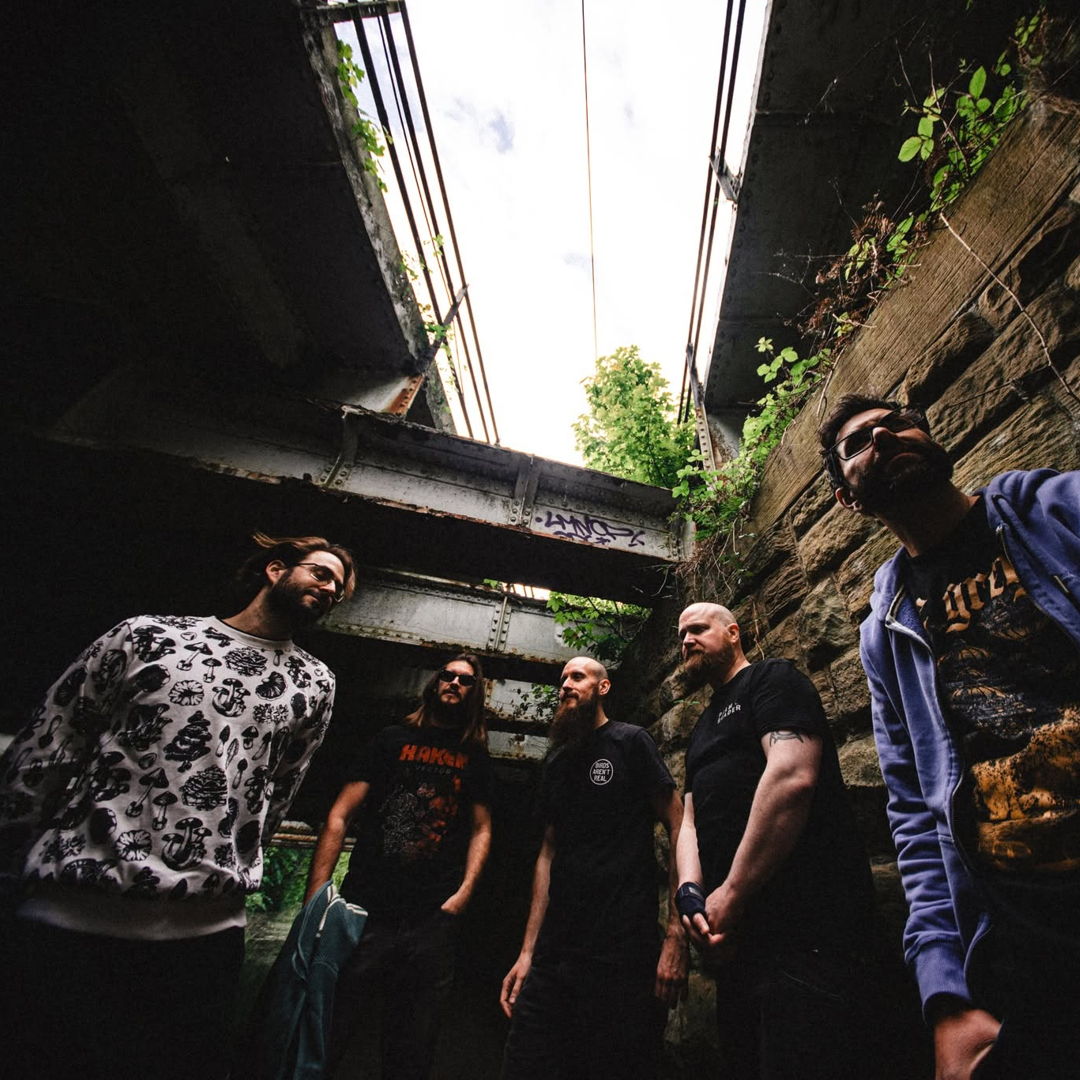
Post-rock can take you anywhere. Occasionally, it spends ten minutes looking for the departure gate. On ‘Takeoffs & Landings’, DIN OF CELESTIAL BIRDS have a clearer idea of where they’re going—and why you might want to come along.
There’s an unwritten agreement in instrumental rock: the band supplies the landscape, and the listener arrives with something to project onto it. Memories, ambitions, unresolved feelings. Whatever survived the working week.
The arrangement works beautifully until atmosphere becomes an excuse for very little to happen. A delay pedal is a wonderful invention. It cannot take responsibility for the entire composition. DIN OF CELESTIAL BIRDS understand the difference.
We first featured the Leeds quintet in 2023, when ‘The Night Is for Dreamers’ became one of our favourite discoveries of the year. Their ‘Live at dunk!fest2024′ release brought us back in 2025, documenting how convincingly those intricate arrangements translated into a shared physical experience.
Now ‘Takeoffs & Landings’ – released via Big Scary Monsters (Caspian, Delta Sleep, mewithoutyou, Tangled Hair, yndi halda…) – gives that developing identity more momentum. Its eight tracks explore travel, adventure and movement through life. A suitably broad itinerary, with considerably more at stake than finding your luggage.
The opening title track gets underway immediately. In just over three minutes, the band establish melodic direction, rhythmic drive and a sense of scale. For post-rock, this practically qualifies as arriving early.
That economy is one of the album’s strengths. Space survives inside the more immediate writing because it comes from the arrangements: how parts overlap, where the rhythm section pushes, when a texture recedes. Length is available when a song needs it. Nobody appears to be paid by the minute.
Three guitars help, provided they have different jobs.
Andie Gill, Tom Hazlehurst and Chris Core distribute melody, texture and weight across the sound rather than competing to occupy its centre. Bassist Matt Benatan and drummer Vince Knight-Schrijver make those layers move. Listen to the rhythmic interplay in “Migratory Patterns”: competing groupings generate tension before the pulse settles into a more direct groove. The release feels satisfying because the arrangement has earned it.
You can count along. You can also simply enjoy the moment your shoulders understand it.
“Marmoris” makes a similarly effective argument for contrast. Its quieter central passage creates distance before tremolo guitars and blastbeats bring the horizon rushing back. The heavier vocabulary expands what the song can express; it also changes how you remember the calm that preceded it.
“When Suddenly…” introduces synthesizers, substantial riffing and a piano-led interruption. A title that performs a modest but useful public service.
Elsewhere, “You Are My Temple” brings shoegaze-like radiance into the band’s physical sound. Melody remains visible through the density, giving the listener something to hold while the surrounding textures shift.
That balance places the record within reach of And So I Watch You From Afar and Maybeshewill through its energy and melodic clarity, and Russian Circles through its instrumental coordination and weight. The larger emotional spaces will also feel familiar to listeners of MONO and Explosions in the Sky. DIN OF CELESTIAL BIRDS increasingly use those possibilities to shape their own pacing.
Does a crescendo still mean something when you know it’s coming?
Of course. But anticipation alone won’t do the work. What matters is what changes on the way there—and whether the song leaves you feeling differently afterwards.
“I Hope That Road Leads You Somewhere Beautiful, Somewhere You Belong” brings that question into focus. Written as a tribute to Gill’s late partner, it gives the album’s theme a personal gravity. Its restraint lets the melody carry the feeling without insisting on a huge final release.
Travel becomes something more complicated here: continuing, remembering, finding a place for what accompanies you. The music leaves room for listeners to bring their own experience into that space.
Recorded with Joe Clayton at No Studio and mastered by Brad Boatright, the album benefits from definition as much as force. You need to hear the relationships between the instruments for these arrangements to work. By the closing “Second Star to the Right, and Straight On ’Til Morning”, the band can gather their different instincts into a longer arc without losing that clarity.
Our earlier features followed a discovery and then its arrival on a significant stage. This chapter gives us a band making sharper decisions about movement, scale and emotional purpose.
Eight tracks. Plenty of distance covered. Mercifully, no announcement asking whether anyone packed their own feelings.
Keep the emotional baggage. There’s always a room.